We Need To Talk anthology launch

We Need to Talk launch

Last night I attended the South Bank launch event for the We Need To Talk anthology, jointly organised by The Eve Appeal, Kindred and Jurassic London. It was an excellent evening. I finally had face-to-face conversations with several people who’ve previously only been names attached to email conversations, and I also spoke to some Real Actual Proper Authors, who were all very welcoming and generous. And I was even asked to sign the book a few times!

We Need To Talk is available as a paperback direct from Foyles (currently only £4.99!), or as an ebook via Amazon.

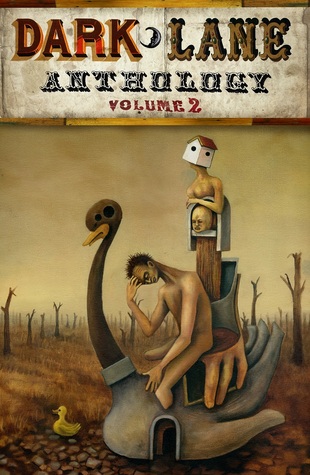
Dark Lane Anthology Volume 2

26243240

Dark Lane Anthology Volume 2 is now available as an ebook from Amazon.com and Amazon.co.uk. You can also buy a print version from Lulu.com – and an Amazon print version will be out soon. (Update: it’s now available from Amazon.com and Amazon.co.uk)

The anthology contains my story, ‘The House Lights Dim’. Though a version of the story appeared a couple of years ago in Sanitarium magazine (my first ever short story sale!), I’ve dramatically reworked it since. It’s better than it was, I think.

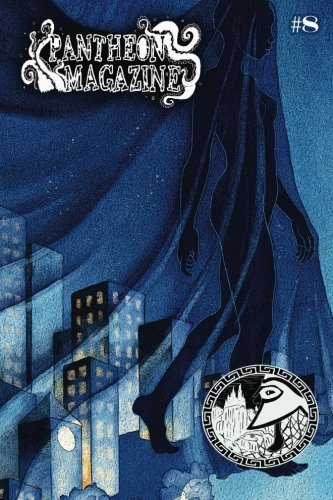
Pantheon #8: Nyx

Pantheon Nyx coverThe print edition of Pantheon #8 is available now and includes a reprint of my story, ‘Finding Waltzer-Three’. This issue of the magazine is themed around Nyx, the Greek goddess of the night.

You can buy the print edition of Pantheon #8 from Amazon.com or Amazon UK – or buy direct from Createspace and use code CFAK5JBZ for a 15% discount. The ebook will be available soon.

We Need to Talk anthology acceptance

We Need to TalkOh, I’m pleased with this one.

My story, ‘Cowardy Custard’, will be included in an anthology called ‘We Need to Talk’, which will be published next month . All proceeds will go to cancer charity, The Eve Appeal.

The book will be published by Jurassic London, a company that’s been at the top of my wishlist ever since I started writing short stories. Good grief, Jurassic London is SO ace.

The Singularity, issue 1

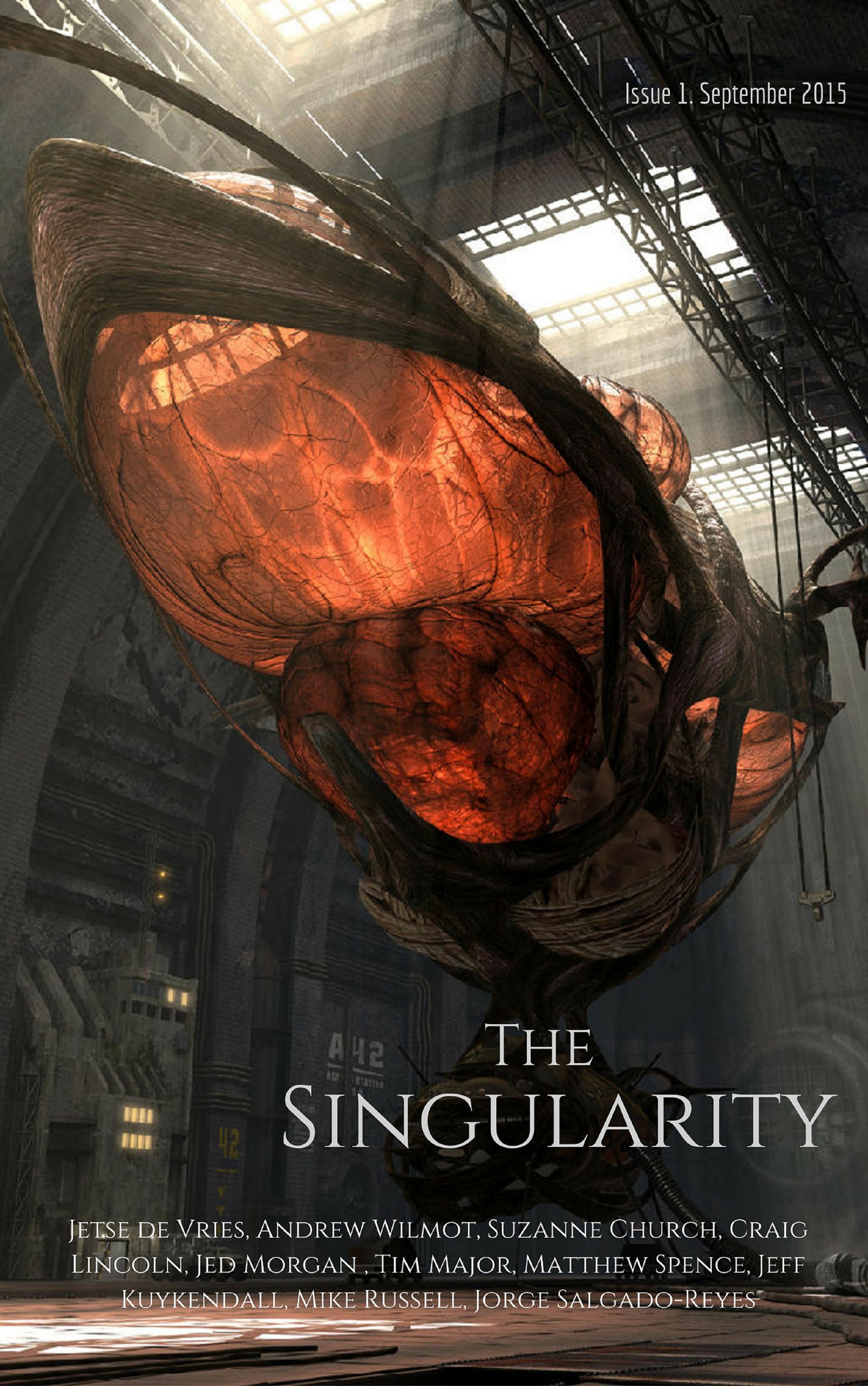
The Singularity Issue 1 Cover

The first issue of the new UK SF magazine, The Singularity, has now been released. (And what a fantastic cover image!) It features a reprint of my story, ‘The Sleeper’. Having said that, the best possible reason to buy it is in order to read Andrew Wilmot’s ‘A Window Into The—’, which is one of the best short stories I’ve read this year.

You can get issue 1 of The Singularity in digital versions from Amazon.com and Amazon UK. Print versions will be coming soon, I’m told. (Update – print editions now available from Amazon.com and Amazon UK)

Game Over anthology

GAME OVER cover - 27.07.15The Game Over anthology is published by Snowbooks today!

It features my story, ‘Lines of Fire’, about two teen boys, an old Bomberman arcade cabinet, and a dark secret.

The eleven other horror stories all feature arcade games in some way and are written by a pretty illustrious group of authors. I’m very proud to be hanging around with them and I’d like to thank editor Jonathan Green for a) picking my story, b) making excellent editorial changes and c) turning the project around with incredible speed.

You can buy Game Over direct from the publisher, or from Amazon UK (print / epub) or Amazon.com (epub).

Kitchen Sink Gothic

KITCHEN SINK GOTHIC FRONT COVERThe Kitchen Sink Gothic anthology from Parallel Universe Publications is now available from Amazon.com (print/epub) and Amazon UK (print/epub).

It includes my story, ‘Tunnel Vision’, about one schoolboy’s dreadful Valentine’s Day. I’ve always been pleased with this story, so I’m very glad to have found it a home.

Kitchen Sink Gothic anthology sale

KITCHEN SINK GOTHIC FRONT COVERMy story, ‘Tunnel Vision’, will be featured in the KITCHEN SINK GOTHIC anthology from Parallel Universe Publications, edited by David and Linden Riley.

I’ve always liked this story, but I was starting to wonder whether I’d be able to sell it. It’s quite personal, and doesn’t feature any SF or supernatural elements, yet it’s a little too creepy to be mainstream. In fact, ‘kitchen sink gothic’ is as neat a descriptor as I can imagine – so I’m delighted that it’s been selected.

KITCHEN SINK GOTHIC will be released as a paperback and ebook in July. You can see the full table of contents on the Parallel Universe Publications website.

Short story: Like Clockwork

SQ Mag Edition 18, featuring my story, ‘Like Clockwork’, is now available for free on the SQ Mag website. ‘Like Clockwork’ took second prize in the Story Quest ‘Punkin’ the Train’ contest at the start of December 2014.

cover-sq-mag-18

It’s the first of my Mars stories (featuring sand-sculpted dwellings, roaming bases and ‘aye-aye’ AI robots) to be published, though it’s one of the most recent I’ve written. More to come, I hope.

Phobos story acceptance

PhobosMore publishing news! I’ve been told that my short story, ‘The Sleeper’, will be published in the third issue of Phobos, the weird fiction magazine based in Philadelphia. I’m really looking forward to reading the magazine!

SQ Mag contest win

SQMag bannerI’ve just been told that my story, ‘Like Clockwork’ has won second place in SQ Mag’s current Story Quest contest. The theme of the contest was ‘Punkin’ the Train’ – though my story isn’t specifically steampunk or dieselpunk etc and I’m not sure which classification might include a Martian sand-sculpted steam train… This nostalgic version of Mars features in several of my stories, but this is the first that’ll be published. I’ve always liked the idea of threading a story/world across several publications, so fingers crossed for that. I don’t yet know which issue of SQ Mag will include ‘Like Clockwork’.

So that’s good news, and offsets a rejection email (for another story) that came through at around the same time. Despite the harshness, I’m very much in favour of this kind of blunt feedback: “The high quality of the writing camouflages that this is a very dull story.  It’s very dry, slow and neither inspires fear or wonder.”

Swings and roundabouts.

‘Finding Waltzer-Three’ Interzone illustration

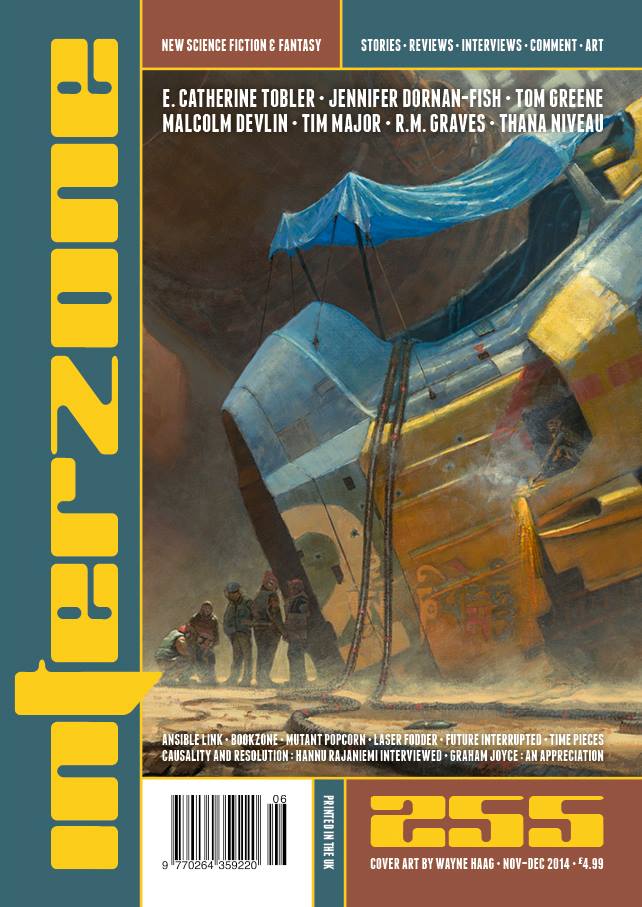
The Interzone team have revealed the illustration for my story, ‘Finding Waltzer-Three’, which appears in issue 255. It’s by Wayne Haag, the same artist who created the terrific cover.

747_largeI love it. It’s the first time that any of my stories has been illustrated. I couldn’t be prouder.

17 Nov 2014 update: And Interzone #255 is available in print now! Click here and scroll all the way to the bottom.

#StoryDecon: ‘A Sound of Thunder’ by Ray Bradbury

002-ray-bradbury-cat_0

This article is filled with spoilers. If you haven’t read it already, you can find the 1952 story itself online here.

Plot summary

In the near future, Eckels, a hunter, pays to travel back in time with a safari group to kill a Tyrannosaurus Rex. When they arrive, the hunters are instructed by the guide, Travis, to stay on a metal path in order to avoid having severe repercussions on the future. Upon seeing the dinosaur Eckels becomes terrified and strays off the path, to Travis’s outrage. Back in the present they find that the world has been subtly changed. Eckels discovers a crushed butterfly on his boot, which has caused the changes. Travis raises his rifle.

Point of view

The story follows Eckels in third person. It’s not a close POV. Some direct thoughts are signalled – for example: ‘Eckels remembered the wording in the advertisements to the letter.’ Others are stated directly: ‘The sign on the wall seemed to quaver under a film of sliding warm water’ (an arresting first line that tells us far more about Eckels’s state of mind than it does about the plot).

Style

Many aspects of the story are related matter-of-factly. In particular, certain central elements are dismissed with a cursory description (the time machine itself is described abstractly: ‘a mass and tangle, a snaking and humming of wires and steel boxes, at an aurora that flickered now orange, now silver, now blue’. Similarly, details of time travel are abstract: ‘First a day and then a night and then a day and then a night, then it was day-night-day-night. A week, a month, a year, a decade! A.D. 2055. A.D. 2019. 1999! 1957! Gone! The Machine roared.’ The return journey through time is described in the briefest possible manner: ‘1492. 1776. 1812.’ There’s also a wonderfully concise explanation of the paradox of meeting oneself in the past: ‘Time steps aside’.

Then, as in other Bradbury stories I’ve read, he lets loose with poetic descriptions, centred on a single vital element. For example, ‘There was a sound like a gigantic bonfire burning all of Time, all the years and all the parchment calendars, all the hours piled high and set aflame.’

Bradbury reserves by the most detailed descriptions for the Tyrannosaurus Rex , including lots of emotive metaphors: ‘Its mouth gaped, exposing a fence of teeth like daggers’ / ‘Its eyes rolled, ostrich eggs’.

Character

Only essential details are given about all characters, including Eckels. Attitudes are neatly conveyed through concise dialogue attributions – for example, ‘”Can these guns get a dinosaur cold?” Eckels felt his mouth saying.’ Peripheral characters aren’t described beyond their function, such as ‘the official’.

Structure

The introduction of the anti-gravity Path is the first hint of the central tension. At this stage, the readers asks: What would happen if a hunter stepped from the Path? Why would that kind of interaction with their environment be prohibited, when killing a dinosaur is permitted? Travis supplies answers soon after, but the method of ensuring that certain animals are safe to shoot seems dubious. If simply stepping on the grass might endanger a nation, surely killing any animal (even two minutes before its natural death) can only be more severe? The reader is left suspicious and doubtful that the safari can end well.

The first time the phrase ‘a sound of thunder’ occurs, it refers both to the arrival of the Tyrannosaurus Rex and the anxiety that Eckels feels. Eckels’s growing fear, and his statement “It can’t be killed,” cranks up the tension.

The details of the changed present-day America may be convenient (while the grammar of the English language has changed, and the election has been won by a fascist party, the Time Safari offices are more or less the same), this allows the point to hit home effectively – i.e. that Eckels’s actions have changed the future. We don’t even need to leave the offices to understand all the repercussions.

The final line is the repeated phrase: ‘There was a sound of thunder.’ This time it refers to the sound of Travis firing his rifle (presumably, shooting Eckels, through rage rather than any hope of righting the error). It mirrors the first use of the phrase, where it conveyed Eckels’s sense of oncoming doom.

What has ‘A Sound of Thunder’ taught me about writing short stories?

  • Save the poetry for aspects that deserve it. Bradbury’s characters and most descriptions serve to push the plot along. But travelling through time and, in particular, the T-Rex warrant the full force of his descriptive skills.
  • Don’t linger. Most of the time-travel ‘rules’ are relayed by Travis. There’s no mucking around with descriptions of the sterilization process or the Path. They’re Macguffins that facilitate Eckels’s journey.
  • End with a punch. While the story’s memorable image is the crushed butterfly (the literal ‘butterfly effect’), this isn’t strong enough to end the story. The reader has expected repercussions from the safari, and the butterfly only explains why the present has been altered. Instead, Bradbury ends the story with the direct threat to Eckels’s life, and the repeated title phrase, which ties the two parts of the story together and makes this a character piece, more than a cold study of a scientific theory.

Read other #StoryDecon articles.