Blog

The peculiar charm of ‘Robot Monster’

Robot MonsterRobot Monster (Phil Tucker, 1953) is a terrible film, but it’s weirdly haunting. The film tells the story of a group of people who, after waking from a picnic nap, find themselves the remaining six people on Earth. Ro-Man, an alien with a diving-helmet head and the body of a gorilla, has destroyed the human population with a combination of nuclear attacks and rampaging prehistoric creatures. Now he’s out to kill the few survivors.

What’s notable about Robot Monster is that its low production values mean that modern viewers are likely to dismiss plot confusions as errors. When the young Johnny encounters Roy and the Professor they’re clearly strangers, yet minutes later we see him address the Professor as ‘father’. The appearance of dinosaurs is baffling, as if the fact that Ro-Man appears not to be able to locate the human survivors despite being only a short walk away. The sort-of sex scene, conducted almost entirely in sign language, is laughably chaste.

But all of these issues are addressed at the end of the film, where we learn that the events were only Johnny’s dreams, inspired by TV adventures. It’s a standard copout, but in this case it’s the only explanation that makes sense. If this were a less overtly awful film viewers would attempt to unravel the inconsistencies and come to the correct conclusion. Strangely enough, it reminded me most of David Lynch’s Mulholland Drive, in which baffling events and inconsistencies can only be explained as dreams. The narrative trick in Robot Monster somehow remains in plain sight, without making itself clear. It’s certainly not a deliberate effect, but it’s strangely satisfying.

The film is full of other treats. Like all my favourite bad films (the incomparable Troll 2 springs to mind), individual moments linger after the film has ended. Ro-Man’s conversation with Johnny is oddly collegiate. The wedding ceremony and subsequent honeymoon in the face of annihilation, whilst clearly insane, is affecting. There are a handful of moments that might act as starting point for genuinely interesting films, or literary novels.

Robot Monster is a terrible film. But I love it.

Announcement: Carus and Mitch

So here’s a thing.

My novella, ‘Carus and Mitch’, will be published by Omnium Gatherum Books in February next year. You can read the announcement on the OG site here.

OG logoAs you can imagine, I’m feeling pretty pleased about it! Omnium Gatherum seems a great home for the story – I discovered the company due to previous titles being nominated for the Bram Stoker and Shirley Jackson awards. I haven’t read any of the other OG authors’ work yet, but you can be sure that I will.

I’m really looking forward to the sequence of editing, proofreading, cover design, and all the other aspects of getting a book to publication. Kate Jonez, who runs Omnium Gatherum, has been wonderful in our email chats so far – I think working with her is going to be fun. I’m also very grateful for her decision to take a punt on a story that’s tricky to classify and, at 17k words, isn’t exactly lengthy… Here’s hoping that readers feel the same, come February!

More ‘Carus and Mitch’ news to follow in due course, no doubt.

Origins of science fiction terms

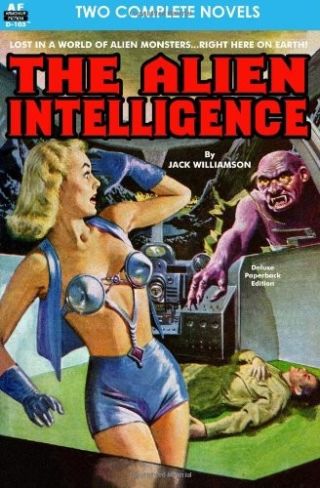
Alien intelligenceThe io9 website this week features a long list of science fiction terms and their origins. Some I was already aware of – I remember reading an article not long ago about cheeky reuses of Ursula K. Le Guin’s ‘ansible’, and William Gibson’s ‘cyberspace’ and Karel Čapek’s ‘robot’ are well documented.

There’s a huge amount of unexpected detail in the article, though. Tracing a first usage of ‘alien’ to mean ‘from another world’ is pretty impressive, for a start. Pinpointing ‘space-ship’ to 1880 is terrific. But my absolute favourite has to be E. E. ‘Doc’ Smith’s coining of ‘tractor beam’ in 1931, in this concise and self-explanatory phrase: ‘Brandon swung mighty tractor beams upon the severed halves of the Jovian vessel’.

Writing update, May 2014

First million words ometer 40Ting!

OK, so my writing spreadsheet didn’t actually go ‘ting’ when I hit 400,000 words, but it should’ve. Anyway, I’m using this tiny milestone as an excuse to summarise my writing up to this point in 2014, following on from my 2013 update.

Short stories

  • A Crest of a Wave (2400 words) – SF, Mars
  • Like Clockwork (3500 words) – SF, Mars
  • Cast In the Same Mould (4200 words) – SF, Mars
  • Finding Waltzer-Three (1400 words) – SF

Longer fiction

I’ve temporarily shelved the historical time-travel novel I was working on from Sept-Dec last year. The main reason is that, with the birth of my son and resultant general exhaustion, the research element was beginning to bog me down. Another good reason is that the main premise seems to share a lot of similarities with a project I’ve heard is in development elsewhere. Grr.

Instead, most of my writing this year has been towards adapting one of my stories, The House-sitter, into a novel. It’s another time travel story for adults, contemporary, and pretty dark. It’s currently running to 56,000 words after a bare-bones first draft. I’m really enjoying writing this one.

Publications

  • By the Numbersanthology reprint, upcoming

And that’s it.

I’m telling myself that this is no bad thing. Since my modest success in getting stories published last year, I’ve set my sights aimed higher and submitted only to semi-pro and pro markets. No bites, but several positive comments, just enough to give me hope. And as I mentioned earlier, my novelette, Carus & Mitch, received an Honorable Mention from the Writers of the Future judges. I got my certificate in the post last night. It’s blue and sparkly.


So, 400,000 words written in total, and 40% of the way to my first million. Not too shabby. So far this year I’ve written around 75,000 words (along with edits of various projects) despite sleepless nights courtesy of my son.

Writers of the Future: minor success

An email this morning informs me that my novelette, Carus & Mitch, has received an Honorable Mention from the judges of the Writers of the Future contest (Q1 2014). It’s a decent result for my first entry to the prestigious SF/F writing contest, and hopefully a sign that I’m on the right track…

However, it’s difficult to know what to do with Carus & Mitch itself, now. Where do 17,000-word novelettes belong, these days?

#StoryDecon: ‘A Sound of Thunder’ by Ray Bradbury

002-ray-bradbury-cat_0

This article is filled with spoilers. If you haven’t read it already, you can find the 1952 story itself online here.

Plot summary

In the near future, Eckels, a hunter, pays to travel back in time with a safari group to kill a Tyrannosaurus Rex. When they arrive, the hunters are instructed by the guide, Travis, to stay on a metal path in order to avoid having severe repercussions on the future. Upon seeing the dinosaur Eckels becomes terrified and strays off the path, to Travis’s outrage. Back in the present they find that the world has been subtly changed. Eckels discovers a crushed butterfly on his boot, which has caused the changes. Travis raises his rifle.

Point of view

The story follows Eckels in third person. It’s not a close POV. Some direct thoughts are signalled – for example: ‘Eckels remembered the wording in the advertisements to the letter.’ Others are stated directly: ‘The sign on the wall seemed to quaver under a film of sliding warm water’ (an arresting first line that tells us far more about Eckels’s state of mind than it does about the plot).

Style

Many aspects of the story are related matter-of-factly. In particular, certain central elements are dismissed with a cursory description (the time machine itself is described abstractly: ‘a mass and tangle, a snaking and humming of wires and steel boxes, at an aurora that flickered now orange, now silver, now blue’. Similarly, details of time travel are abstract: ‘First a day and then a night and then a day and then a night, then it was day-night-day-night. A week, a month, a year, a decade! A.D. 2055. A.D. 2019. 1999! 1957! Gone! The Machine roared.’ The return journey through time is described in the briefest possible manner: ‘1492. 1776. 1812.’ There’s also a wonderfully concise explanation of the paradox of meeting oneself in the past: ‘Time steps aside’.

Then, as in other Bradbury stories I’ve read, he lets loose with poetic descriptions, centred on a single vital element. For example, ‘There was a sound like a gigantic bonfire burning all of Time, all the years and all the parchment calendars, all the hours piled high and set aflame.’

Bradbury reserves by the most detailed descriptions for the Tyrannosaurus Rex , including lots of emotive metaphors: ‘Its mouth gaped, exposing a fence of teeth like daggers’ / ‘Its eyes rolled, ostrich eggs’.

Character

Only essential details are given about all characters, including Eckels. Attitudes are neatly conveyed through concise dialogue attributions – for example, ‘”Can these guns get a dinosaur cold?” Eckels felt his mouth saying.’ Peripheral characters aren’t described beyond their function, such as ‘the official’.

Structure

The introduction of the anti-gravity Path is the first hint of the central tension. At this stage, the readers asks: What would happen if a hunter stepped from the Path? Why would that kind of interaction with their environment be prohibited, when killing a dinosaur is permitted? Travis supplies answers soon after, but the method of ensuring that certain animals are safe to shoot seems dubious. If simply stepping on the grass might endanger a nation, surely killing any animal (even two minutes before its natural death) can only be more severe? The reader is left suspicious and doubtful that the safari can end well.

The first time the phrase ‘a sound of thunder’ occurs, it refers both to the arrival of the Tyrannosaurus Rex and the anxiety that Eckels feels. Eckels’s growing fear, and his statement “It can’t be killed,” cranks up the tension.

The details of the changed present-day America may be convenient (while the grammar of the English language has changed, and the election has been won by a fascist party, the Time Safari offices are more or less the same), this allows the point to hit home effectively – i.e. that Eckels’s actions have changed the future. We don’t even need to leave the offices to understand all the repercussions.

The final line is the repeated phrase: ‘There was a sound of thunder.’ This time it refers to the sound of Travis firing his rifle (presumably, shooting Eckels, through rage rather than any hope of righting the error). It mirrors the first use of the phrase, where it conveyed Eckels’s sense of oncoming doom.

What has ‘A Sound of Thunder’ taught me about writing short stories?

  • Save the poetry for aspects that deserve it. Bradbury’s characters and most descriptions serve to push the plot along. But travelling through time and, in particular, the T-Rex warrant the full force of his descriptive skills.
  • Don’t linger. Most of the time-travel ‘rules’ are relayed by Travis. There’s no mucking around with descriptions of the sterilization process or the Path. They’re Macguffins that facilitate Eckels’s journey.
  • End with a punch. While the story’s memorable image is the crushed butterfly (the literal ‘butterfly effect’), this isn’t strong enough to end the story. The reader has expected repercussions from the safari, and the butterfly only explains why the present has been altered. Instead, Bradbury ends the story with the direct threat to Eckels’s life, and the repeated title phrase, which ties the two parts of the story together and makes this a character piece, more than a cold study of a scientific theory.

Read other #StoryDecon articles.

#StoryDecon: ‘Man from the South’ by Roald Dahl

Roald DahlThis article is filled with spoilers. If you haven’t read it already, you can find the 1948 story itself online here.

Plot summary

An Englishman spends time beside the swimming pool of a Jamaica hotel. He meets a man from South America, then they are joined by an American sailor and an English girl. The mysterious man proposes a bet: if the sailor can successfully light his lighter ten times in a row, he will win the man’s Cadillac; if he fails, the man will chop off the sailor’s little finger. The sailor takes the bet and, in the man’s hotel room, they set it up. After the sailor reaches eight successful strikes of the lighter, a woman enters. She informs the group that the man is an inveterate gambler, that the Cadillac is hers, and that she has won all of the man’s possessions for herself. The narrator sees that her hand is missing three fingers.

Narrator and POV

The narrator is an unnamed Englishman. He’s a barely-involved observer to the main events of the plot. The story is told in first person perspective, close but with direct thoughts attributed using phrases like ‘I told myself’.

One of the main functions of the narrator’s involvement in the story is that his observations tell rather than show: ‘There was a silence then, and I could see that the little man has succeeded in disturbing the boy with his absurd proposal.’ And later, ‘She seemed an awfully nice woman.’ In fact, Dahl uses the narrator to sum up the situation several times, as in: ‘I didn’t know what to make of it all. The man seemed serious about the bet and he seemed serious about the business of cutting off the finger. But hell, what if the boy lost?’

Style

The tone is precise (‘I went over and sat down under a yellow umbrella where there were four empty seats’) and, at the start, mild (‘It was pleasant to sit and watch the bathers splashing about in the green water’).

There are very few descriptions involving metaphor, so they are impactful when they appear (‘She shook him so fast you couldn’t see him any more. He became a faint, misty, quickly moving outline, like the spokes of a turning wheel.’)

Some aspects probably wouldn’t be as readily accepted in modern stories. The man’s phonetically-presented dialogue (‘”Excuse pleess, but may I sit here?”’) becomes frustrating, or at least unnecessary. Dahl uses the verb ‘was’ a lot, when perhaps more active verbs might have served the story better – although some may argue that it blunts and simplifies the tone, usefully.

Character

Character descriptions are all very neat, like this description of the sailor: ‘He was about nineteen or twenty with a long freckled face and a rather sharp birdlike nose. His chest was not very sunburned and there were freckles there too, and a few wisps of pale-reddish hair.’. Importantly, they’re consistent for each character, too, referring to common details each time – a later description of the sailor is ‘the boy with the long freckled face and the pointed nose, bare-bodied except for a pair of faded brown bathing shorts’. The man from the South becomes gradually more sinister through innocuous actions such as ‘The little man clapped his hands together quietly, once.’

Structure

Essentially, the structure involves planting the seed of an idea (the bet), then creating tension about: a) whether the boy will take the bet; b) whether he will succeed. The impact of the final reveal is that the sailor nearly lost his finger for nothing, as well as undermining what we think we know about the man from the South.

The plot – that is, the bet – is foregrounded over character and setting. We learn little about each character beyond their initial descriptions, and it’s four hundred words into the story before we learn that it’s set in Jamaica.

In the 1979 Tales of the Unexpected TV adaptation, the pace slows dramatically for the setup and execution of the bet. Each flick of the lighter is drawn out. It’s interesting that, in the story, Dahl chooses not to do this, as it seems a moment ripe for drawing out tension.

The story ends with the reveal that the woman has only a finger and a thumb. I expect that most readers conclude that she won everything from the man through bets that he himself set up, eventually getting lucky. (An alternative reading is that the finger-chopping bet is her own invention, and that the man is a poorer gambler than she is, despite the fact that she has lost many times in order to win overall.) We learn that the man is, in many ways, a hopeless victim, and that the woman (his wife?) is the truly formidable character.

But the most important aspect is ending on the shock reveal of the woman’s hand. Only in the final line is the tale revealed as retrospective, allowing Dahl to amp up the narrator’s horror: ‘I can see it now, that hand of hers; it had only one finger on it, and a thumb.’

What has ‘Man from the South’ taught me about writing short stories?

  • It’s OK to keep character descriptions simple in a plot-centric story. Reusing character description tags may solidify the reader’s mental image of each character.
  • In a plot-centric story, keep the focus fixed totally on the premise.
  • Consider the pacing of key moments. It’s worth questioning whether moments of obvious tension – the execution of the bet – should be drawn out (as in the Tales of the Unexpected adaptation) or relayed at the same pace as the rest of the story.
  • Make sure shock endings are rich, not cheap. The final reveal of the woman’s hand is more than simply a ‘punchline’. It undermines what we thought we knew, and raises questions. However, just before this moment the woman provides answers to many of our initial questions, so it’s a satisfying ending.
  • Shock endings shouldn’t leave the reader stranded. In this story, the woman’s intrusion marks the end of the bet and therefore the plot. Presumably, the narrator, sailor and English girl would have been ushered out of the room moments later, so the reader’s experience of events matches the narrator’s own.

Read other #StoryDecon articles.
Deconstructing short stories

Storydecon twitter logo

In late September my wife and I had a baby boy. Every day with my son is a thrill, but there are minor downsides, including the fact that my novel-reading speed has tanked.

That’s not the only reason that I’ve decided to concentrate on reading short fiction this year. I write SF short stories and have had a couple published, but I tend not to read short fiction for pleasure. This seems ridiculous – would you give the time of day to a would-be novelist who didn’t read novels? The more stories I write, the more I realise that I don’t quite understand the conventions of short fiction, or even what I enjoy most.

I’m not interested in reviewing short stories critically. Published stories have been endorsed, whereas mine languish in magazine editors’ inboxes, so who am I to criticise? I’m interested in deconstructing stories in order to understand how they tick.

I’ll keep updating this list as an index of #StoryDecon articles:


My writing in 2013

Short stories written in 2013

  • The Walls of Tithonium Chasma (2400 words) – SF, Mars
  • The Sleeper (1600 words) – SF, Mars
  • The House-sitter (7200 words) – SF, time travel
  • Tunnel Vision (2000 words) – general
  • To Ashes, Dust (2500 words) – SF, Mars
  • The Man Screaming His Scream (1200 words) – SF
  • First Cashpoint on Mars (1000 words) – SF, Mars

Flash fiction written in 2013

  • The Puzzle Box (250 words) – horror, entry for Apex flash fiction competition
  • A Christmas Tradition (250 words) – horror, entry for Apex flash fiction competition

Longer fiction written in 2013

  • Mercy (73,000 words) – YA novel, finished & edited
  • Carus & Mitch (16,500 words) – horror novelette, finished & edited
  • Untitled time travel novel (25,000 words and counting) – in progress

Short stories published in 2013

By my reckoning, that’s about 138,000 words written this year (including deleted words, excluding planning and editing). Not bad going, whilst working full time and taking two months off after the birth of my son…

Combined with stories and novels from the previous two years, I’ve written about 320,000 words of fiction in total. I read somewhere that writers only find their voice, or write anything worth a damn, after completing their first million words.

First million words ometer 32That feels about right.

Favourite tracks of 2013

Hungry Face by Mogwai – the most perfect theme imaginable to my favourite TV show of the last few years. / Casino Lisboa by Dirty Beaches – my most-listened new track of the year. I love the moment about a minute in, when the drums kick in and knock the bass riff upside-down. / New York / It’s All About… by Marina Rosenfeld – NY performance artist Rosenfeld is joined by Warrior Queen for a sparse, echoing shoutout. / Fall Back by Factory Floor – endless and hypnotic. Can’t shake the disappointment that the eventual album didn’t contain more like this. / Ludwig’s Children by Roj – a bedtime treat from the former Broadcast member’s early tape work EP, The Amateur’s Attic. / The Weighing of the Heart by Colleen – the aural equivalent of finding yourself dozing off beneath a tree on a sunny autumn day. / Major Tom by The Space Lady – recorded in 1990 and reissued on her Greatest Hits album, predates Julia Holter and Grouper with only a Casio and a winged hat. I’ve had this track on constant rotation since its release. / Low Light Buddy of Mine by Iron & Wine – Sam Beam moves even closer to a MOR sound, but this track’s an absolute earworm. / Water Park Theme – Take 2 by Dirty Beaches – the other side of Alex Zhang Hungtai’s 2013 output, as serene as ‘Casino Lisboa’ is frantic. / Brennisteinn by Sigur Ros – spluttering amps, synths and guitars, this is a tweaked sound for Sigur Ros, but the sense of bewildered glory is still present and correct. / LDWGWTT by SHXCXCHCXSH – unrelenting techno from the unpronounceable Swedish duo. / Full of Fire by The Knife – the rotten heart of Shaking the Habitual. / Breaking up the Earth by Colleen – frankly, I could include most of The Weighing of the Heart here, but I’m limiting myself to two tracks. This one’s more Arthur Russell than Grouper. / Willow by Rosy Parlane – one of a number of great Touch ambient tracks I might have included, and difficult to pinpoint what’s special about it. It just is. / Where Are We Now? by David Bowie – as wonderful as it was to have Bowie reappear out of nowhere, this track has only improved with each listen. / So Far So Clean by  Inga Copeland – a nice match with Marina Rosenfeld’s EP, the female half of Hype Williams finally strikes out on her own, hinting at excellence to come. / Waayey: The Butcher by Sidi TouréAlafia is an excellent, uplifting album. This track in particular does it for my three-month-old son. / Iyongwe by John Wizards – avoiding the Vampire Weekend-isms of the rest of the album, this track straddles genres perfectly. / Universe in Crisis by Wareika Hill Sounds – former Skatalite Calvin ‘Bubbles’ Cameron plays trombone in a fudgy, late-night haze. / Not Your Ordinary Blanket (live) by Groupshow – a track that I can only grasp onto for a few minutes before it merges into whatever daydream I’m in. / Hello Stranger by Julia Holter – a match made in heaven as Holter performs a stunning cover of Barbara Lewis’s song, one of my favourite ever pop tunes. / 10.17.2009 (for CCG) by M. Geddes Gengras – formless, pulsating, overwhelming.

Here’s a Spotify playlist containing all the tracks, just shy of 2 hours:

Favourite albums of 2013

colleen-weighing-cover

The Weighing of the Heart by Colleen

From the first hummed note of ‘Push the Boat Onto the Sand’ to the final echoing cello plucks of the title track, Cécile Schott’s latest is an exercise in swooning beauty. Lullaby-like rhymes and melodies appear and overlap, choral vocals become lost under layers of delicate rhythms. The sampling trickery is subtle and disarming, ‘Ursa Major Find’ and the single-phrase ‘Break Away’ feel at times like sweeter takes on Laurie Anderson’s ‘O Superman’. But the outstanding moments are instrumental: ‘Geometría del Universo’ and particularly ‘Breaking Up the Earth’ channel Arthur Russell’s World of Echo. Colleen succeeds at fusing the sweet and genuinely, unnervingly progressive. Each time I listen to The Weighing of the Heart I fall in love with it all over again.


Drifters & water park

Drifters / Love is the Devil and Water Park OST by Dirty Beaches

There’s an obscene generosity to the amount of music that Alex Zhang Hungtai has provided in 2013. The Water Park soundtrack is beguiling at first, little more than a hum heard from another room. But I’ve listened to this 28-minute EP countless times and now playing it is like hearing the sound of something remembered from childhood. It’s simple and beautiful.

The double album Drifters / Love is the Devil is another beast, at least at first. The first half represents more familiar Dirty Beaches territory – Suicide casio thumps and rockabilly-from-hell vocals swamped in reverb. This reaches a peak with the compellingly riffy Casino Lisboa, my personal song of 2013.  The second half of the CD revisits the same aural soundscapes as Water Park. Less essential, certainly, but packaging Drifters and Love is the Devil together is a throwaway gesture that most artists wouldn’t dare contemplate.


Dozzy

Plays Bee Mask by Donato Dozzy

Bee Mask’s Vaporware EP is pretty great. But this album, in which Italian techno producer Donato Dozzy, remixes the title track again and again over seven tracks, is outstanding. I’ve listened to a lot of ambient music this year, but there are few albums that manage to be both moodily evocative and also lodge themselves in your mind. I get the feeling that the circumstances of this piece couldn’t be replicated.


UR055_COVER_F

Collected Works Vol. 1 – The Moog Years by M. Geddes Gengras

More ambient perfection. Sun Araw, Akron/Family and LA Vampires collaborator Gengras fiddles about with Moog Rogue and MG-1 synths and creates something divine. The track ‘10.17.2009 (for CCG)’ is an aural swoon.


Other albums in the mix

Albums 2013 rack

Shaking the Habitual by The Knife, for its bloodymindedness, magnificent bloat and a handful of thumping pop hits. The entire Mallet Guitars series by Ex-Easter Island Head, culminating in this year’s Mallet Guitars Three, all EPs together forming an essential album. Exit! By Fire! Orchestra, some of the most terrific free jazz, despite being tricky to schedule into a working day. And finally, The Space Lady’s Greatest Hits, long-awaited and wonderful.


EPs

EPs

Live at Skymall by Groupshow –  like many of my favourite albums this year, a listen that merges with whatever activity you’re doing. P.A./Hard Love by Marina Rosenfeld, a surprising favourite given its abrasive unpredictability, but totally compelling. No More War by Wareika Hill Sounds for chilled, alien trombone tunes.


Favourite record labels

Thrill Jockey (new releases from Matmos, People of the North, Mouse on Mars’ Jan St. Werner, Sidi Touré). Room 40 (Bee Mask, Marina Rosenfeld), Touch (Chris Watson, Rosy Parlane, Mika Vainio, Bruce Gilbert & BAW) Hospital Productions (Vatican Shadow, Rainforest Spiritual Enslavement, Alberich).


Favourite albums overall, new to me, from any year

Suicide (Suicide, 1977), an album that made me furious that nobody had introduced the band to me before. Womblife (John Fahey, 1997), produced by Jim O’Rourke and featuring some of the wonkiest sounds imaginable. Moondog & His Friends (Moondog, 1953) , an eye-opening account of the Viking of Sixth Avenue. I Am Sitting in a Room (Alvin Lucier, 1981), a simple sonic experiment that morphs into something intangible and ethereal. Illuminations (Buffy Sainte-Marie, 1969), apparently abandoned by the artist but superb and alien. Strumming Music (Charlemagne Palestine, 1974), another experiment with warmth and humour. We’re Only In It For the Money (Frank Zappa & The Mothers of Invention, 1968) – batshit insane. Everybody Knows This Is Nowhere (Neil Young & Crazy Horse, 1969)  – everybody else loves this album already, evidently, and it was mostly familiar to me, but hearing the tracks together was a revelation. And, already mentioned above, The Weighing of the Heart (Colleen, 2013) and Drifters / Love is the Devil (Dirty Beaches, 2013) are the two albums that stand out this year.

Favourite films watched in 2013

Warning to the Curious

Other than Alfonso Cuarón’s essentially perfect Gravity (see my review), the only other 2013 film I saw that was worth a damn was Stoker (Chan-wook Park), a terrific and seedily terrifying reimagining of Hitchcock’s Shadow of a Doubt.

As for the rest of my film viewing, A Warning to the Curious (Lawrence Gordon Clark, 1972) was one of the most unsettling film experiences I can remember, up there with Jerzy Skolimowski’s The Shout (1978). Night of the Demon (Jacques Tourneur, 1957) was an expected pleasure. Whether or not the demon should have been omitted, as per Tourneur’s original intentions, is moot. With or without it, this is a peculiar masterpiece. I found Persona (Ingmar Bergman, 1966) striking and shocking – pop-culture familiarity still doesn’t prepare you for the experience. Sunrise (F. W. Murnau, 1927) was another absolute surprise – far more melodramatic than I’d imagined, but also far more dry and blunt, too. And it was a vast relief to see a (relatively) modern film with as much time to pay to its characters as Together (Lukas Moodysson, 2000), an unflinching and strangely warm account of communal living.

Favourite books read in 2013

Rabbit

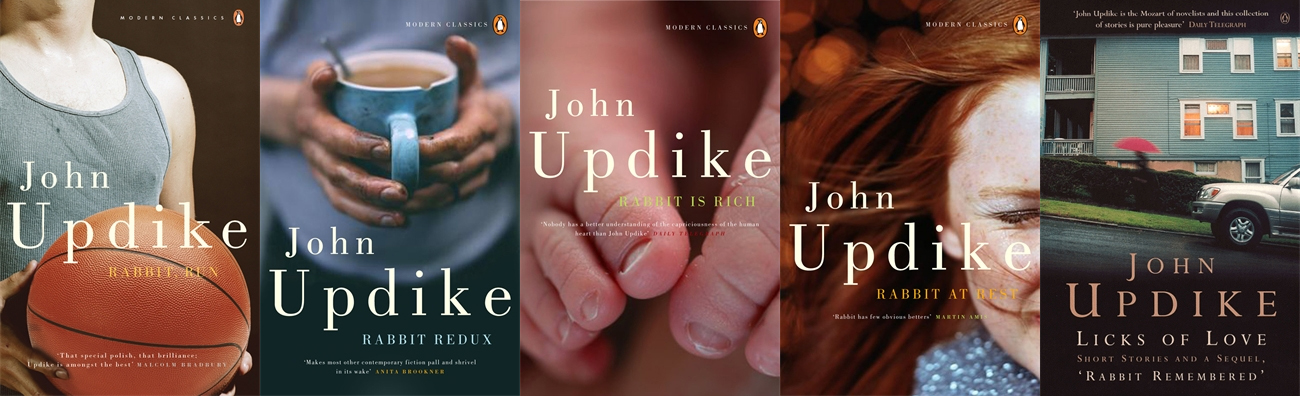
Harry ‘Rabbit’ Angstrom novels (John Updike, 1960-2000)

I found reading Rabbit, Run (1960) a revelation. Its third-person, present-tense point of view lends the story an immediacy, but that would be nothing without Updike’s immaculate observational powers. That vast sections of the novel feature nothing more dramatic than Harry driving around in the dark, yet are still gripping, speaks volumes. While I found the switch to Janice’s point of view the least satisfying element, stylistically, the narrative bombshell dropped still makes me choke.

Reading a novel that you fully connect with is wonderful. Discovering subsequently that you have the ability to follow the same characters over forty years at decade-long intervals… that’s a rare treat. Rabbit Redux (1971), Rabbit is Rich (1981), Rabbit at Rest (1990) and the novella Rabbit Remembered (2000) each cover subtly different aspects of changing American culture and, more importantly, of the psyche of the average American male. Taken as a complete work, they are as perfect a novel as I think I’m ever likely to read.


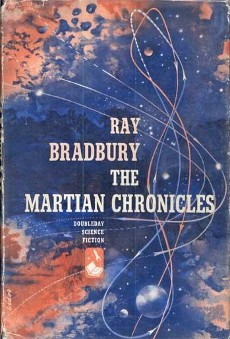
The-Martian-ChroniclesThe Martian Chronicles (Ray Bradbury, 1950)

This ‘half-cousin to a novel’ (Bradbury’s own words) comprises 28 loosely connected stories. Most of them had been published previously in the late Forties in various SF magazines. In collecting them here, Bradbury traces connecting lines between stories and recurring characters. The effect is a disorienting series of snapshots that nevertheless builds up a far more complete vision of the future than a more straightforward novel.

And what a vision! At times, Bradbury’s prose can be staggeringly beautiful. For example, from ‘The Locusts’: The rockets set the bony meadows afire, turned rock to lava, turned wood to charcoal, transmitted water to steam, made sand and silica into green glass which lay like shattered mirrors reflecting the invasion, all about. Bradbury’s Mars, modelled in the image of the memories of homesick astronauts, tells us far more about nostalgia for one’s childhood than about the Red Planet.

At heart, my favourite science fiction has little to do with science. I may have only read it for the first time this year, but The Martian Chronicles is my favourite science fiction novel.


Other EyesOther Days, Other Eyes (Bob Shaw, 1972)

A down-at-heel scientist accidentally creates glass that holds its image for years. Inventions, breakthroughs and problems ensue.

I read this in a couple of sittings, amazed at how much mileage Bob Shaw gets from a simple, hypothetical invention. The eventual use of ‘slow glass’ as a surveillance tool prefigures issues topical today: CCTV and Google’s Streetview and Glass projects. Throughout the novel, interspersed sections paint vignettes of different aspects of life that have been irrevocably changed by the invention of slow glass, many of them heartbreaking.

While the main plot may wrap up a little too quickly, and the love interest is under-developed, Shaw’s novel dwells on the human resonances of an important breakthrough. I’ll be searching out more of his novels in 2014.

Favourite TV shows of 2013

Returned

The Returned (Canal+, Channel 4) was hands-down my favourite TV programme of the year, and up there with my favourite ever. Its glacial pace, the steady gaze of the camera, terrific performances, Mogwai’s perfect soundtrack, made every situation gripping. Not since Twin Peaks have I felt such a familiarity with each location in a TV series. The ending may have baffled, but I have high hopes for the next season, whenever Canal+ choose to broadcast it.


Count Arthut

Count Arthur Strong (BBC) is a very traditional sitcom, the likes of which would be hard to imagine being commissioned before Miranda Hart’s repopularisation of the form. Despite the show’s long gestation period, the first episode is as perfect a sitcom script as I’ve seen. Middle episodes flag a little, but the warmth of Steve Delaney’s Arthur allows for some surprising turns, resulting in heartbreaking scenes in episode 6.

 Adventure

An Adventure in Time and Space (BBC) Easily my highlight of Doctor Who’s 50th Anniversary year. Mark Gatiss found the perfect throughline in William Hartnell’s reluctance and later warming to the role of the Doctor. David Bradley’s performance was eerily perfect and the reconstructions of classic scenes were exactly the type of nostalgic trip that I’d been hoping for.


The summer months of 2013 were bizarrely filled of weighty, risk-taking television. Jane Campion’s The Top of the Lake introduced us to seedy New Zealand rednecks with a mystery that remained fascinating until the disappointing final reveal. Channel 4’s Run ventured into experimental territory with four interconnected tales, each reflecting different aspects of London communities. Christopher Guest’s Family Tree was a genial ramble led by Chris O’Dowd and featuring aimless cameos from everybody funny ever. The final half-season of Breaking Bad began to creak at the edges but still retained all of its promise until the final episode where it inevitably frayed at the edges, unable to support the weight of its own complicated lore. And Arrested Development Season 4 remained a vast disappointment, despite being more-or-less everything that a long-serving fan might have wished for.

Short story: Read/Write Head

Garbled logo

This morning saw the new issue refresh of the Garbled Transmissions website. It features my short story, Read/Write Head.

Read/Write Head was based on a one-sentence premise that I discovered in an old notebook (“How would it feel to defragment your mind?”) and was then written much faster than my other stories. The word associations were generally those that occurred to me first; the main character has my name as a reflection of the many personal links.

Read the full story here.

Gravity (Alfonso Cuarón, 2013)

Gravity

Alfonso Cuarón’s Gravity makes good on the promise of the Lumière brothers’ L’Arrivée d’un Train en Gare de la Ciotat. Although stories of the Lumière film terrifying spectators may be myth, the 1895 film is an immersive experience, even today. It’s all spectacle and zero plot and it operates perfectly.

Gravity features a plot, but only barely. It’s the most basic type of thriller: it sets up a difficult situation, piles on the peril, and then allows us to watch its protagonist try to grapple with the problem. It’s a rollercoaster ride, almost literally. The camera swings and banks, carrying the viewer along – except it can achieve far more than just thrills of simulated motion. As in David Fincher’s Fight Club (1999), the fluidity of the CGI camera allows us unprecedented and unexpected access to characters. One moment in particular stands out as a cinematic watershed: the camera views Ryan Stone’s panicked face, then seeps through the visor of the spacesuit to view the projected readouts and view of the Earth from within. It reveals far more about Stone’s predicament than any dialogue or facial expressions. Cuarón trusts viewers to empathise with characters through shared experience.

For such a lean and kinetic film, there are a surprising number of static moments. While some viewers have found Stone’s foetal position too bluntly symbolic, it functions as a peculiar and necessary still centrepoint, following one exhausting experience and preceding others. Similarly, the dialogue isn’t much to write home about, but again functions as shorthand. Finally, although it may have wrongfooted some cinemagoers, the casting of Sandra Bullock and George Clooney fits Cuarón’s approach perfectly. He has so little interest in developing backstory for the characters (What kind of doctor is Stone? What’s the purpose of her scientific project? What do we know about Clooney’s Matt Kowalski at all?) that the familiar, A-list faces serves as shorthand. It allows the film to clock in at a tight 91 minutes, dispensing with the usual flab of Hollywood blockbusters.

Gaming and subcultures in Little Brother

MMORPG 2In Little Brother, Cory Doctorow demonstrates that social gaming communities can give rise to independent subcultures.

At the start of the novel, Marcus Yallow and his friends take part in an alternate reality game (ARG), Harajuku Fun Madness. The game involves clues hidden around major cities, forming a overlaid network over ordinary society. The ARG foreshadows events later in the book, where Marcus’s resistance network must remain hidden whilst still interacting with society.

Similarly, Marcus has experience of live action role-playing games (LARPs). Again, his experience involved playing the games in public, therefore producing a gaming layer over everyday life. Importantly, these LARPs involved dressing as vampires, linked to goth subcultures at the fringes of society. Marcus uses his knowledge of ARGs and LARPs to stage the politically-motivated gathering at the end of the novel.

With the internet monitored by the Department of Homeland Security (DHS), Marcus uses a modified Xbox console to communicate with his peers. Significantly, the hardware is designed for gaming, now adapted for political use. Large corporations are symbolically aligned with the DHS, as the teenagers use Microsoft’s hardware for unauthorised purposes.

The Xnet itself is similar to chatrooms and forums that surround internet gaming culture. The massively multiplayer online role-playing game (MMORPG), Clockwork Plunder, becomes less a game and more a legitimate social space for Xnetters to congregate, eventually becoming the home of the Xnet’s first press conference.

All of these examples are social activities that began as gaming experiences, adapted by Marcus and his friends for political means. Eventually, the situation is reversed: new game-like experiences arise from purely political activities. When Marcus meets the young teens Nate and Liam, he sees that they treat ‘jamming’ as an ARG, albeit one of which their victims are unaware.

In this way, Doctorow demonstrates that social subcultures and political movements can easily become merged, feeding into one another.

Submitted to Coursera as essay 10 for Fantasy and Science Fiction: The Human Mind, Our Modern World.
Coursera peer grade: Form 2 / Content 2

Image from Invertika / Wikimedia Commons

The Left Hand of Darkness and the ‘I’ of Ai

1eyeball004Ursula Le Guin’s choice of the name ‘Ai’ for the protagonist of The Left Hand of Darkness reveals a preoccupation with subjectivity, perception and the ‘other’.

The fact that ‘Ai’ and ‘eye’ are homophones is no coincidence. Genly Ai functions as the ‘eyes’ of the Ekumen, observing the Gethenians. Furthermore, although Ai states that ‘The story is not all mine, nor told by me alone’, he has selected all of the elements of the novel – it is ultimately experienced through his eyes.

Of course, ‘Ai’ also sounds like the word ‘I’. The novel is a personal tale of Ai’s life-altering experiences on Gethen. His own self-image changes during his travels with Estraven, to the extent that his Ekumen colleagues appear like ‘a troupe of great, strange animals’ in comparison to gender-neutral Gethenians.

Many Gethenians deny Genly Ai’s status. He encounters scepticism about the existence of worlds beyond Gethen and is labelled a liar and a ‘pervert’ due to his physiognomy. Ai’s name (‘I’) functions as a protest that he should be considered equal and capable of independent opinion.

However, no Gethenian makes this linguistic connection. When Estraven initially enquires about Ai’s name he perceives the sound differently. He hears in the answer ‘a cry of pain from a human throat across the night’, illustrating instead his own fear of the alien ‘other’.

The reason is not just that Gethen is isolated. Karhide and Orgoreyn are locked in a cold war, without contact, struggling for domination without war. In the same way that Gethen sees itself as alone in the galaxy, both realms refuse to cooperate with each other. As far as each is concerned, they alone are ‘I’, holding out against the ‘other’.

In short, Genly Ai’s name acknowledges that he is a reader surrogate, but also serves a narrative purpose, highlighting the conflict with characters that he encounters.

Submitted to Coursera as essay 09 for Fantasy and Science Fiction: The Human Mind, Our Modern World.
Coursera peer grade: Form 2 / Content 3

Nostalgia in The Martian Chronicles

640px-MarsSunsetCut

In The Martian Chronicles, we are told that the colonists arrive ‘with small dreams or big dreams or none at all’. However, throughout the stories Bradbury suggests that the motivating factors for many characters are nostalgia and the clarity of early memories.

In ‘The Third Expedition’, John Black is easily tricked by the Martian’s use of his own memories to populate the town. When he sees his parents, he ‘[runs] up the steps like a child to meet them’. His unquestioning acceptance may be difficult to understand at first, but throughout the stories Bradbury shows that each group of colonists yearns for reminders of its past. Although Anna LaFarge in ‘The Martian’ says of her dead son Tom, ‘He’s been dead so long now, we should try to forget him and everything on Earth’, she and her husband perpetuate the illusion that the Martian is Tom in order to cling on to their nostalgic memories. Similarly, in ‘The Long Years’, Hathaway eases his isolation by creating robot versions of his family.

Nostalgia also fuels other aspects of the characters’ psyches. Father Peregrine’s memories of fire balloons fuels his evangelical religious convictions. In ‘Way in the Middle of the Air’, Samuel Teece’s memories of night-time attacks on black people involve ‘laughing to himself, his heart racing like a ten-year-old’s’.

Many characters demonstrate that their ambitions extend only to a recreation of familiar Earth occupations. For example, the luggage-store owner states, ‘We came up here to get away from things’, yet his job selling luggage to people returning to Earth is regressive. Sam Parkhill, in ‘The Off Season’, has travelled to Mars only to set up a hot dog stand.

Bradbury shows us that the visitors to Mars, like European colonists of America, are not searching for a new world, but rather a safe place to recreate their own past.

Submitted to Coursera as essay 08 for Fantasy and Science Fiction: The Human Mind, Our Modern World.
Coursera peer grade: Form 2 / Content 2

Edgar Rice Burroughs and the Martian canals

Martian canals

Edgar Rice Burroughs’s vision of Mars in A Princess of Mars [1] owes a debt to Percival Lowell’s astronomical observations, but itself propagated a specific image of the planet in the public consciousness.

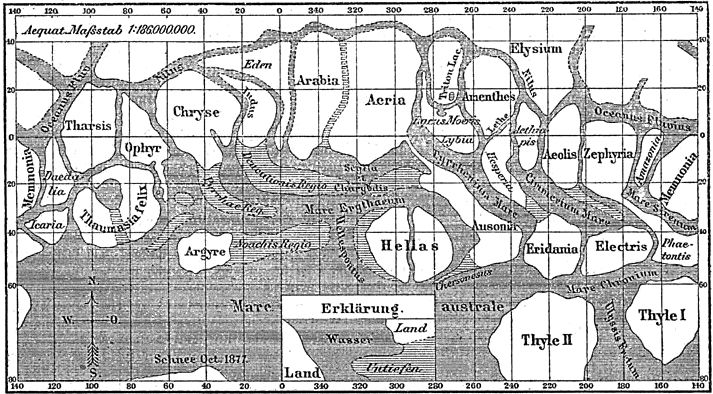
In 1895, Percival Lowell published Mars [2], a summary of his observations of the planet. His descriptions of Martian ‘canals’ were influenced by the Italian astronomer Giovanni Schiaparelli’s references to ‘canali’ [3 – see image], more properly translated as ‘channels’ or ‘gullies’. The concept of Martian canals, in this and Lowell’s later works [4], fuelled many people’s belief that Mars was an inhabited, ruined world.

Burroughs, who was aware of Lowell’s theories, included ‘the famous Martian waterways, or canals, so-called by our earthly astronomers’ in his vision of Mars. The canals have primary importance in the novel, controlled by the red Martians and the source of conflict between the races of the planet. Extrapolating from Lowell’s vision of a ruined world, Burroughs introduced Atmosphere Plants, combating the environmental threat of extinction of life. In his descriptions of ‘arid and semi-arid land’, ‘ruined edifices of the ancient city’ and ‘partially ruined towers of ancient Thark’, Burroughs aligned John Carter’s observations to Lowell’s popularly-believed findings.

While Lowell did influence other writers at the time of the publication of his work, including H.G. Wells’s The War of the Worlds [5], it was Burrough’s Barsoom series that proved the greater catalyst for the public perception of Mars. The concept of Martian canals remains popular today, as well as being a staple in literary depictions of the planet. Canals appear in The Martian Chronicles [6] by Ray Bradbury, who ‘admired Burrough’s Martian tales because they were romantic and moved the blood as much as the mind’ [7]. Many writers who later became prominent science-fiction authors were similarly influenced at an early age by Burroughs’s vision of Mars.

References
[1] Edgar Rice Burroughs – A Princess of Mars (1917)
[2] Percival Lowell – Mars (1895)
[3] Historical map of planet Mars by Giovanni Schiaparelli (1888)
[4] Percival Lowell – Mars and Its Canals (1906)
[5] H.G. Wells – The War of the Worlds (1898)
[6] Ray Bradbury – The Martian Chronicles (1950)
[7] Aaron Parrett, Introduction: Edgar Rice Burroughs – The Martian Tales Trilogy, Barnes and Noble edition (2006)

Submitted to Coursera as essay 07 for Fantasy and Science Fiction: The Human Mind, Our Modern World.
Coursera peer grade: Form 2 / Content 2.5

Religion in H.G. Wells’s stories

Country of the BlindDoctor MoreauH.G. Wells’s story, The Country of the Blind, and novel, The Island of Doctor Moreau, offer a critique of the function of religion in society.

In The Country of the Blind, Nunez encounters an isolated community whose inhabitants are blind. His descriptions of the sense of sight, and objects he sees around him, are dismissed by the inhabitants. Their proof – that they believe to be incontrovertible – is a religious explanation. The religious origin story is centred around touch, including the belief that above them is a ‘cavern roof […] exquisitely smooth to the touch’.

Nunez’s facility of sight allows him to dispute the beliefs, but he is unable to convince the population of their error. Their conviction, and his love for Medina-saroté, almost leads him to agree to be blinded. The story ends with Nunez high in the mountains, looking at ‘the illimitable vastness of the sky’. His own understanding of the truth is preferable to accepting a false religious doctrine.

In The Island of Doctor Moreau, the creatures have adopted Moreau’s initial prohibitions as doctrine. ‘The Law’ is a series of rules, some humanist (‘Not to chase other Men’) and some for Moreau’s own purposes (‘Not to eat fish’ is arguably morally arbitrary, but Moreau wishes to avoid them becoming carnivorous).

Once again, our narrator, Prendick, is in a position to witness the folly of a new religious code. His outsider status allows him to see that the Law, and the deification of Moreau as creator (‘His is the Hand that makes’), is a method for the creatures to rationalise the world and their own existence.

In both tales, Wells suggests that organised religion can arise in any closed community to explain the world and humanity’s function within it. Furthermore, the narratives illustrate that these deeply-held convictions can be misleading and potentially dangerous without being balanced by reason and open-minded observation.

Submitted to Coursera as essay 06 for Fantasy and Science Fiction: The Human Mind, Our Modern World.
Coursera peer grade: Form 2 / Content 2

Art versus life in Hawthorne and Poe

Butterfly etchingPoe’s The Oval Portrait and Hawthorne’s The Artist of the Beautiful both illustrate the Romantic artist’s preoccupation of art in favour of everyday life, but reach very different conclusions.

In Poe’s story, a painter’s portrait of his wife consumes him. Initially the painting is a tribute to the real woman, ‘proof not less of the power of the painter than of his deep love for her’. Becoming ever more obsessed with the painting in favour of the woman, on completion he remarks ‘This is indeed Life itself!’, only to see that his wife has died.

There are many similarities between Poe’s story and Hawthorne’s The Artist of the Beautiful. Like Poe’s painter, Owen Warland dedicates himself to ‘putting spirit into machinery’, to the detriment of his profession and relationships. After shunning his would-be sweetheart Annie Hovenden, he loses touch with the outside world. When he has finally created the mechanism, Annie is married and has a child.

Whereas Poe’s story is a straightforward indictment of favouring art over life, Hawthorne’s story is more complex. Initially, butterflies symbolise to Warland a ‘beautiful idea’ that he aspires to mimic with machinery. When he succeeds, the mechanism is, to all intents and purposes, a butterfly. Whether or not he is its creator has become irrelevant: he now appreciates the majesty of the real butterfly. When the butterfly is crushed by Annie’s wilful child, Warland – who created the box showing an image of a boy in pursuit of a butterfly – understands that the search for the beautiful is itself the ‘beautiful idea’.

There is a striking difference between the stories. Poe suggests that favouring art over life results in the loss of corporeal treasures, leading to despair. While Hawthorne’s story supports this incompatibility of approaches, it suggests that pursuing an artistic ideal is a noble undertaking, with transcendent rewards.

Submitted to Coursera as essay 05 for Fantasy and Science Fiction: The Human Mind, Our Modern World.
Coursera peer grade: Form 2 / Content 2